She is the Pitambara Devi — robed in golden yellow, seated on a throne of pure gold, and invoked by Lord Shiva himself. A complete guide to her origin, iconography, stambhana power, and place among the Dasa Mahavidyas.
Before creation, before light, before the gods — there was only the Supreme Divine Mother. Everything that exists unfolds from her.
The universe was created by the Supreme Divine Mother — Adi Para Shakti. The five great elements (fire, air, water, earth, and space), the planets, all living beings, the celestial and lower realms, the gods, the asuras, and all human beings — each one originates from her divine power alone.
She does not stand apart from creation as a distant overseer. She is creation. She manifests and sustains the cosmos through the eternal, unbroken cycle of Srishti (creation), Sthiti (preservation), and Samhara (dissolution). When one cycle ends, another begins — and through every turning, she remains unchanged.
Across different ages and circumstances — when the balance of dharma was disturbed, when creation needed protection or correction — Adi Para Shakti manifested in specific sacred forms, each fitted to a precise purpose. Ten of these manifestations are revered together as the Dasha Mahavidyas: the Ten Great Wisdom Goddesses.
Bagalamukhi is the eighth among them. Her arising was not incidental — she was called into being at a moment of cosmic crisis, when the very foundations of existence were threatened by a storm of such force that the worlds faced annihilation. It was then that the golden-robed Devi emerged from the waters of Haridra Lake, took form, and stilled the storm with a single gesture.
All that Adi Para Shakti creates is woven from five primordial elements — agni (fire), vayu (air), jal (water), prithvi (earth), and akasha (space). Bagalamukhi's golden form — both her robe and her throne — aligns her with agni and solar energy: the illuminating, transformative force at the heart of creation.
The three-phase cosmic cycle is not merely metaphysical — it is mirrored in every human life, every season, every thought. Bagalamukhi, as the one who can arrest movement and speech, embodies the hinge-point between Sthiti and Samhara: the instant where preservation tips into dissolution. To invoke her is to stand at that hinge.
The Devi Bhagavata Purana narrates that during a world-destroying storm, Lord Vishnu propitiated Adi Para Shakti. She arose in her Bagalamukhi aspect from the sacred Haridra (turmeric-yellow) Lake in Saurashtra, halted the storm instantly, and restored the three worlds to order. This is why turmeric — haridra — is the sacred offering at all Bagalamukhi rituals.
The ten forms of Adi Para Shakti are not equal in the worship of the Trinity. Three of the Mahavidyas hold a singular distinction — each is invoked by Brahma, Vishnu, or Shiva as their primary mantra.
The Creator worships through
Matangi Mantra
The Preserver worships through
Tara Mantra
Mahadeva himself worships through
Bagalamukhi Mantra
This is what places Bagalamukhi above all other forms in power and reach.
Each Mahavidya embodies a distinct quality of the Supreme Mother — a specific power, a specific purpose, a specific path of approach.
Rajas Guna form · Dissolution of ego and time · Destroyer of illusion
Rajas Guna form · Worshipped by Vishnu · Guide across the ocean of existence
Sattva Guna form · Beauty of the three worlds · Sovereign of creation
Sattva Guna form · Ruler of the cosmos · Space herself as divine form
Rajas Guna form · Power of decay and transformation · Fierce teacher
Rajas Guna form · Self-sacrifice and the paradox of life from death
Tamas Guna form · The widow goddess · Void before manifestation
All three Gunas · Worshipped by Shiva · Stambhana Shakti · This page
Sattva Guna form · Worshipped by Brahma · Speech, music, arts
Sattva Guna form · Mahalakshmi aspect · Abundance and grace
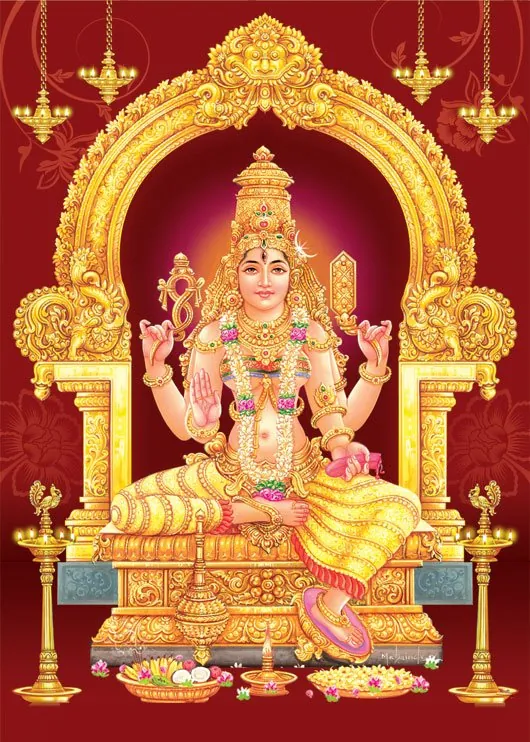
Every detail of Bagalamukhi's iconography carries layered meaning. To contemplate her form is itself a form of meditation.
Dhyanam Shloka · Bagalamukhi Tantra
सौवर्णासन संस्थितां त्रिनयनां पीतांशुकोल्लासिनीम्
हेमाभांगरुचिं ससांक मुकुटां सचम्पक श्रग्युताम्
हस्तैर्मुद्गरपाशवज्ररसनां संबिभ्रतीं भूषणैः
व्यप्तांगीं बगलामुखीं त्रिजगतां संस्तम्भिनीं चिन्तयेत्
Listen to the pronunciation
"Contemplate Bagalamukhi — seated on a golden throne, three-eyed, radiant in yellow garments, her body glowing like pure gold, crowned with the crescent moon, garlanded with champak flowers, holding in her four hands the mace, the noose, the thunderbolt, and the tongue of the enemy — she who arrests the three worlds."
She is four-armed (chathurbahu). Her robe is entirely yellow — pitambara — the colour of turmeric, of gold, of solar fire, of auspiciousness. Her skin glows like molten gold (hemabha). She is three-eyed (trinayana): the third eye signifies the knowledge that sees beyond duality. The crescent moon in her crown links her to Shiva's lineage and to the rhythms of time.
Yellow pervades everything associated with Bagalamukhi worship. Her robe, her throne, the offerings made to her, the silk worn by the acharya during ritual — all yellow. This is not arbitrary. In the tantric colour system, yellow corresponds to haridra (turmeric), which is understood to carry Devi's own essence. The Haridra Lake of her origin is yellow. Her yantra is drawn with turmeric paste. Even devotees performing personal sadhana are instructed to wear yellow during worship.
She is adorned with garlands of champak (Michelia champaca) flowers — deep golden-yellow blossoms associated with beauty, prosperity, and divine fragrance. The champak garland reinforces the Sattva Guna aspect of her form: the side that blesses, beautifies, and grants abundance rather than the side that strikes and restrains.
She is not seated on an animal vahana, as many deities are. Her throne is pure gold (sauvarṇāsana). This is the throne of absolute sovereignty — she is not mounted, not in motion, not in transit. She is still, centred, and supreme. To approach her is to approach stillness itself.
Stambhana — the Sanskrit root means to fix in place, to immobilise, to arrest. It is the power of the earth's stillness in the face of the sky's movement. And it is Bagalamukhi's defining power — the one quality that no other Mahavidya possesses to the same degree.
When she seizes the demon's tongue with her left hand, she does not merely silence one voice. She demonstrates a universal principle: hostile speech, hostile thought, hostile movement — all can be arrested at their source. The tongue is the instrument of slander, false witness, cursing, and incitement. By seizing it, she reaches the origin of harm before it can propagate.
The Maha Mantra of Bagalamukhi names each faculty of the enemy explicitly: vācham (speech), mukham (face/expression), pādam (movement), jihvām (tongue), buddhim (intelligence). She stills each one separately and completely. This is why she is invoked in court cases, litigation, slander, black magic, and any situation where a hostile intelligence must be neutralised.
Arresting hostile speech — slander, false testimony, incitement. The most commonly invoked aspect in disputes and court cases.
Immobilising the enemy's actions, plans, and agency. Invoked for protection against abhichara (black magic) and organised opposition.
Dissolving the hostile intelligence itself — rendering the enemy unable to devise further harm. The deepest level of her protective power.
Every force in creation operates through one of three fundamental qualities. Most Mahavidyas embody one or two. Bagalamukhi alone holds all three — simultaneously and in perfect balance.
The Sankhya philosophy identifies three gunas — qualities that permeate all matter and energy in creation. Sattva is clarity, harmony, and truth. Rajas is activity, passion, and drive. Tamas is inertia, dissolution, and darkness. Nothing in creation exists outside these three qualities; their interplay determines the character of everything that exists.
Among the Dasa Mahavidyas: Matangi, Bhuvaneshwari, Tripurasundari, and Mahalakshmi are Sattva Guna forms — they radiate peace, grace, and auspiciousness. Mahakali, Tara, Bhairavi, and Chhinnamasta are Rajas Guna forms — active, fierce, and transformative. Dhumavati alone stands in Tamas Guna — the void, the unmanifest. Only Bagalamukhi embodies all three. This is the foundation of her unparalleled power.
Clarity · Grace · Auspiciousness
Expressed in the Pitambara form: yellow robes, golden throne, champak garlands, the Varada Mudra of blessing. She grants Mangalya Siddhi (marriage), Santhana Siddhi (children), Sowbhagya (happy marriage), Dhanabhagya (wealth), and Arogya (health).
Activity · Force · Victory
Expressed in the weapons: the mudgaram (mace), the paasam (noose), the vajrayudha (thunderbolt). She provides victory in litigation, resolution of disputes, dissolution of shatru karma, and defeat of opposition at every level.
Arrest · Dissolution · Silence
Expressed in the act of seizing the tongue: absolute immobilisation of hostile speech and agency. She also dissolves diseases from past-birth karma, Pithru Saapam (ancestral curse), Naga Dosham, and the ill effects of malefic planets.
Because she holds all three gunas, she can be made angry easily — and equally easily pleased. This is not a warning of danger; it is a description of sensitivity. A Devi of this proximity responds to the sincerity of the worshipper quickly and completely — in both directions.
For most of India's history, Bagalamukhi worship was found only in Himachal Pradesh. That changed when Sree Suryamangalam Advaitha Veda Vidhya Peetam brought her presence to Tamil Nadu.
Sree Bagalamukhi (Peetambara) Devi has only two temples consecrated to her worship in all of India. One stands in Himachal Pradesh, in the northern mountains. The other is Sree Suryamangalam Bagalamukhi Devi Temple, at Pappankulam Village, Kallidaikurichi, in the Tirunelveli District of Tamil Nadu — the first and only Bagalamukhi temple in the entire South.
It was Sree Suryamangalam Advaitha Veda Vidhya Peetam that took this extraordinary step. The Peetam, based in Virugambakkam, Chennai, had been performing Sree Bagalamukhi Devi Yaaga according to Thaantric Vidhi for over twenty-five years before the temple was built. The sacred Yaagaagni — kindled from Arani — had been kept alive and unbroken for more than twenty of those years. The Bagalamukhi Devi Mantra Aahuthi count had crossed one crore repetitions.
It was from this unbroken lineage of practice — and with the personal blessing and foundation-stone laying of His Holiness Sri Kanchi Kamakoti Peetathipathi Jagadguru Poojyasri Sri Sri Jayendra Saraswathi Sankaracharya Swamiji — that the temple was consecrated.
This temple is the only one in the world where the Chathurbahu Vigraham — the four-handed idol — is consecrated and worshipped in strict accordance with the Dhyana Sastra Vidhi. The Vedic and Aagama Sastra methods used at other temples are deliberately not adopted here; the nature of Bagalamukhi Devi demands complete adherence to the Thaantric method.
The Peetam's founder, Rajaguru Brahmasri Guruvayur Vishvamithra Gothra Suryan Namboothiry Acharyar (Peetathipathi), received the titles of Rajaguru and Aasthaana Vidwan from Sri Kanchi Kamakoti Peetam in 2006, in recognition of his depth of knowledge in Hindu Veda Sastra, Astrology, and Thanthra Sastra.
The sacred fire drawn from Arani — the Yaagaagni — has been kept alive and unbroken at the Peetam for over twenty-five years. Every yagam at the temple is performed from this same lineage of fire: one crore-plus mantra repetitions, 10,000 chants per yagam, every sankalp entered directly into the Yaagaagni by the devotee.
Clear answers to the questions devotees and seekers ask most often about Bagalamukhi Devi, her significance, and how to approach her.
Sree Bagalamukhi is the eighth of the ten Dasa Mahavidyas — the Ten Great Wisdom Goddesses who are manifestations of Adi Para Shakti, the Supreme Divine Mother. She is the only form among all ten who holds all three gunas (Sattva, Rajas, and Tamas) simultaneously. According to the Devi Bhagavata Purana, she arose from the Haridra Lake in Saurashtra to arrest a world-destroying storm at Lord Vishnu's prayer. Her name derives from bagala (bridle or halter) and mukhi (face) — she is the one who halts, who arrests, who places a bridle on hostile force. She is most distinctively identified as the Devi of Stambhana — the power to immobilise hostile speech, movement, and intelligence.
Pitambara is a compound of pita (yellow) and ambara (garment or sky). She is called Pitambara Devi because every element of her divine form is yellow: her robe is yellow silk, her throne is gold, her body glows with the colour of turmeric and molten gold, her garlands are of champak blossoms (deep golden-yellow). The colour connects her to haridra (turmeric) — the sacred offering at all Bagalamukhi rituals — and to the Haridra Lake of her mythic origin. In tantric colour symbolism, yellow signifies solar fire, auspiciousness, and the transformative energy that both purifies and protects. All devotees performing Bagalamukhi sadhana are instructed to wear yellow, and the acharya performing the ritual also wears yellow throughout.
Stambhana (Sanskrit: स्तम्भन) means the act of arresting, immobilising, or fixing in place. It is Bagalamukhi's signature power — the one quality that distinguishes her from all other Mahavidyas. In her iconic depiction, her left hand seizes the tongue of a prostrate enemy, while her right hand raises the mace to strike. This gesture is a direct demonstration of Vak Stambhanam — the arrest of hostile speech at its source.
Stambhana is invoked in: court cases and litigation (where opposing testimony must be neutralised), slander and false accusation, situations involving black magic or abhichara (intentional harm through occult means), and cases where a persistent enemy continues to cause damage despite conventional efforts. The Maha Mantra — vācham mukham pādam stambhaya jihvām kīlaya buddhim vināśaya — names each faculty (speech, face, movement, tongue, intelligence) that is to be arrested.
For most of recorded temple history, there was only one Bagalamukhi Devi temple in India — the ancient temple in Himachal Pradesh. The first Bagalamukhi temple in South India — and only the second in the country — was established by Sree Suryamangalam Advaitha Veda Vidhya Peetam at Pappankulam Village, Kallidaikurichi, Tirunelveli District, Tamil Nadu. The foundation stone was laid personally by His Holiness Sri Kanchi Kamakoti Peetathipathi Jagadguru Poojyasri Sri Sri Jayendra Saraswathi Sankaracharya Swamiji — a consecration that conferred the highest legitimacy on the new temple. The Peetam had been performing Bagalamukhi Yaaga according to Thaantric Vidhi for over twenty-five years before the temple was built, and the Yaagaagni had been kept unbroken for more than twenty of those years. Today the temple at Pappankulam is the only one in the world where the Chathurbahu Vigraham (four-handed idol) is worshipped strictly by Dhyana Sastra Vidhi.
Bagalamukhi sadhana requires initiation and guidance — it is not a practice to begin casually or without a teacher. The Thaantric tradition that governs Bagalamukhi worship has specific requirements: the practitioner wears yellow, the puja space is set up with yellow flowers (ideally champak or yellow marigold), turmeric is the primary offering, and the mantra must be received with correct pronunciation from a qualified acharya.
The most appropriate first step for most devotees is to attend a yagam at Sree Suryamangalam Temple — either in person or by booking a sankalp for the Amavasya Yagam or Pournami Yagam. At these yagams, every mantra is chanted 10,000 times with homam, and devotees are given the direct opportunity to dedicate their personal prayer into the Yaagaagni. This is considered a complete and powerful form of the sadhana in itself. For those who wish to begin personal mantra repetition, contact the temple office: Rajaguru Brahmasri Guruvayur Vishvamithra Gothra Suryan Namboothiry Acharyar (Peetathipathi) or the temple acharyas can provide guidance appropriate to your situation.
The Sree Suryamangalam Bagalamukhi Devi Temple performs every yagam with your name, nakshatra, and gothram — in the full presence of the Devi. Whether you travel to Tirunelveli or book from afar, Amma hears your sankalp.
Questions? Call +91 98416 27471 · or email admin@sreebagalamukhidevitemple.com