 To the Devas
Deva Yajña
Homa — honouring the divine forces that sustain the cosmic order.
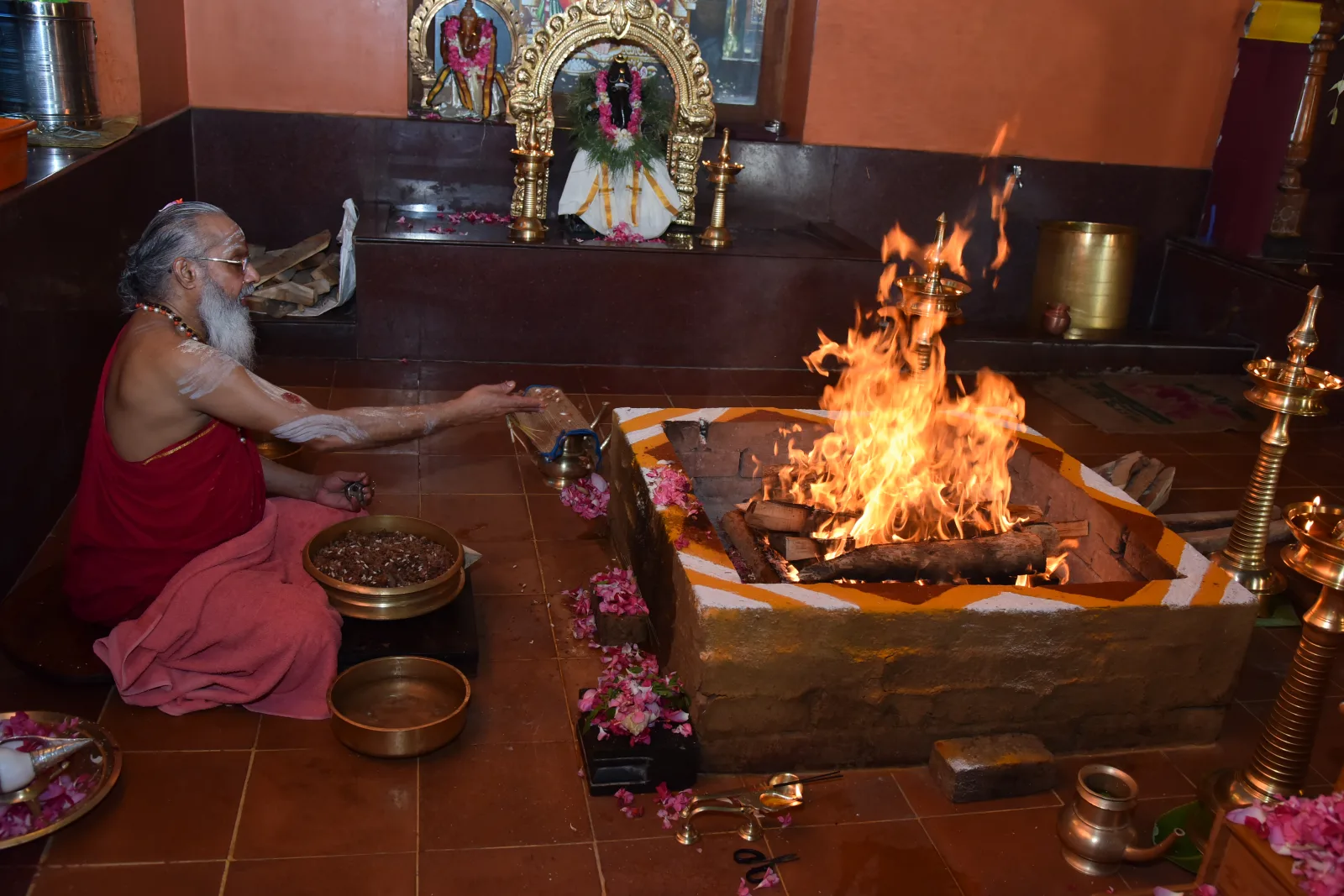
Deva Yagna is the offering made through Agni — with mantra, āhuti and sankalpa — invoking the grace of the Devas for the well-being of the devotee and the family.
Life is sustained by forces greater than ourselves.
The Vedic tradition teaches us not merely to receive from them — but to recognise them, honour them, and participate in that sacred order through yajña.
The Ṛṣis saw the universe not as a collection of separate things but as a single interconnected order — Ṛta. The sun rises. Rain falls. Crops grow. Life is sustained. A human being receives continuously from forces they did not create and cannot command. Yajña is how one consciously participates in that order.
We receive. We recognise. We offer.
देवान्भावयतानेन ते देवा भावयन्तु वः ।
परस्परं भावयन्तः श्रेयः परमवाप्स्यथ ॥
devān bhāvayatānena te devā bhāvayantu vaḥ
parasparaṁ bhāvayantaḥ śreyaḥ param avāpsyatha
“Nourish the Devas through yajña, and may the Devas nourish you. Nourishing one another, you shall attain the highest good.”
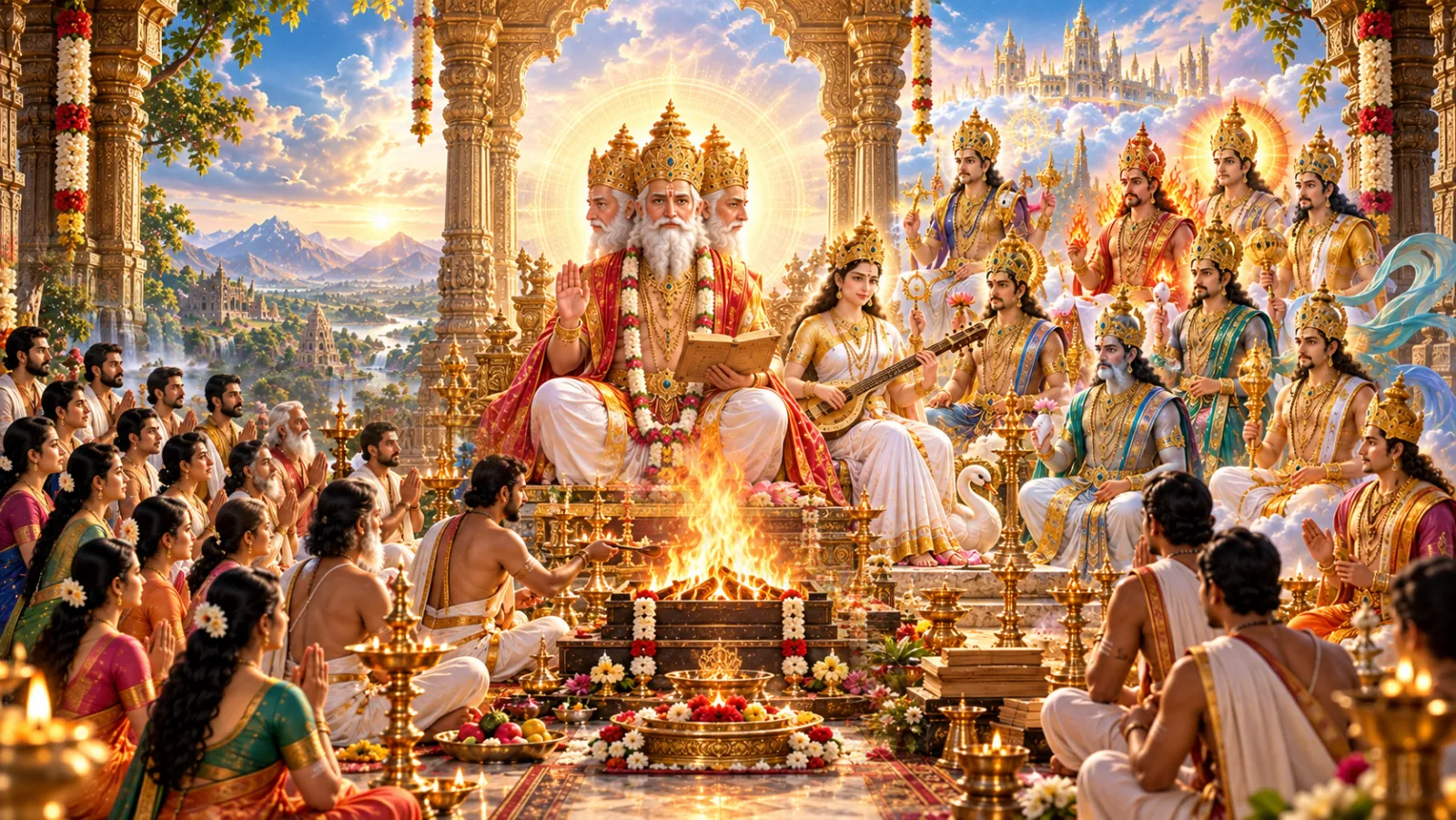
In his discourse series on Sanatana Dharma, Swamiji explains a teaching he calls the Sanatana Dharma Upadesam — the counsel of Lord Brahma, given to the Devas and to human beings at the beginning of creation.
To the Devas was given the duty of sustaining life on earth and bestowing its blessings. To human beings was given the duty of honouring and nourishing the Devas in return — through the Pañca Mahāyajña.
Understood this way, Swamiji teaches, Sanatana Dharma is not first a list of virtues. It is a duty: the duty of the human being to live in reciprocity — with the Divine, the ancestors, the Ṛṣis, every living being, and one another.
सहयज्ञाः प्रजाः सृष्ट्वा पुरोवाच प्रजापतिः ।
अनेन प्रसविष्यध्वमेष वोऽस्त्विष्टकामधुक् ॥
saha-yajñāḥ prajāḥ sṛṣṭvā purovāca prajāpatiḥ
anena prasaviṣyadhvam eṣa vo ’stv iṣṭa-kāma-dhuk
“Having created beings together with yajña, Prajāpati said: through this may you prosper; may it fulfil your worthy aspirations.”
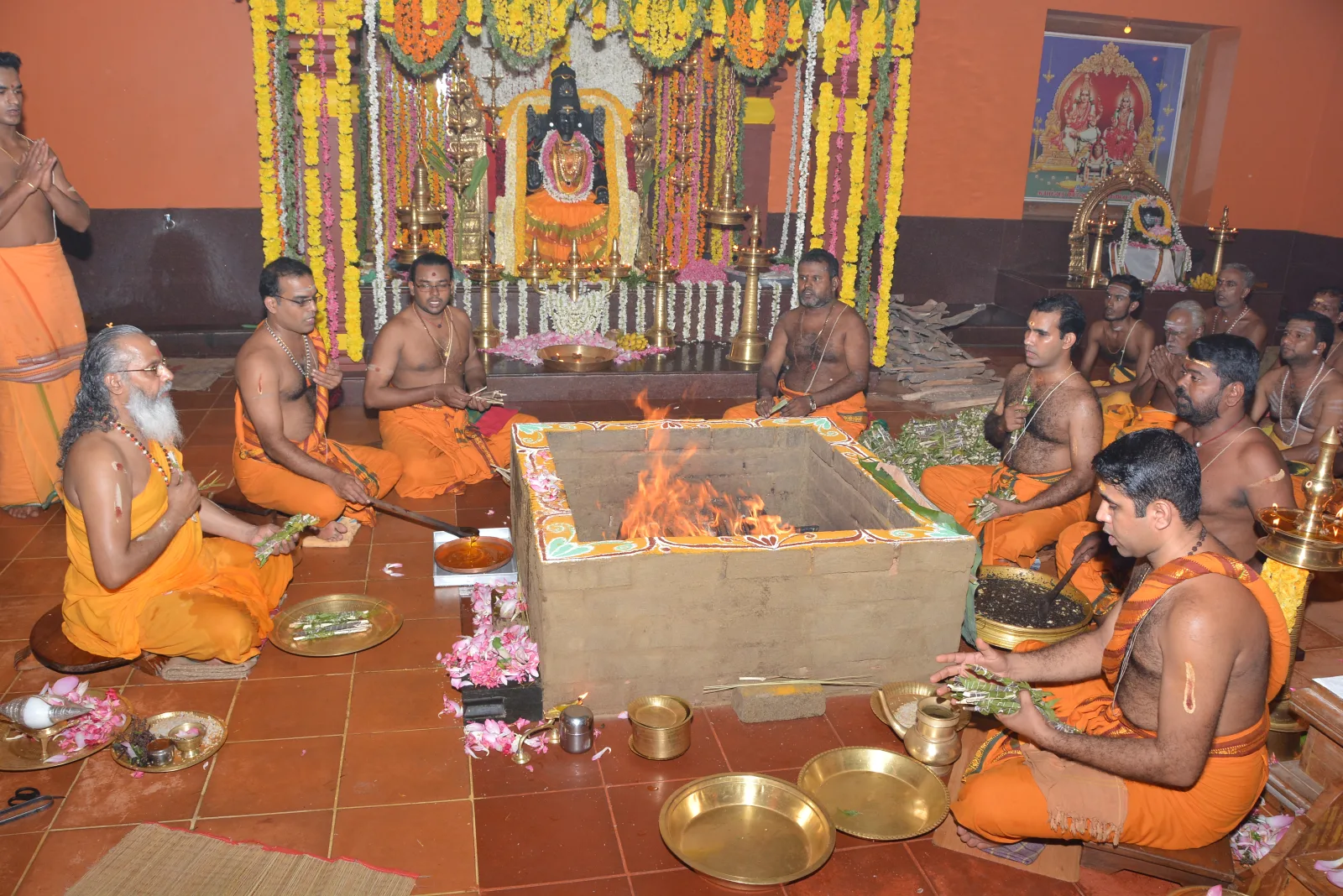
Into the sacred fire an offering is made, with mantra, intention and reverence. What is offered is not merely an object. It is an act of recognition — that life is sustained by forces beyond the individual.
Agni is not merely physical fire. In the Vedic vision Agni is the sacred medium through which an offering is carried to the Devas. As the temple teaches it: because the inner fire of an ordinary person burns poorly, an external sacred fire is established and the deity is invoked into it, so that what is offered is received directly.
The yajña therefore transforms an intention into an offering, and an offering into an act of worship. In the classical definition of the five great daily duties it is the homa that is named as Deva Yajña; the Kūrma Purāṇa describes the Vaiśvadeva rite in the same terms, and teaches that what remains after the offering is to be shared with other living beings.
अन्नाद्भवन्ति भूतानि पर्जन्यादन्नसम्भवः ।
यज्ञाद्भवति पर्जन्यो यज्ञः कर्मसमुद्भवः ॥
annād bhavanti bhūtāni parjanyād anna-sambhavaḥ
yajñād bhavati parjanyo yajñaḥ karma-samudbhavaḥ
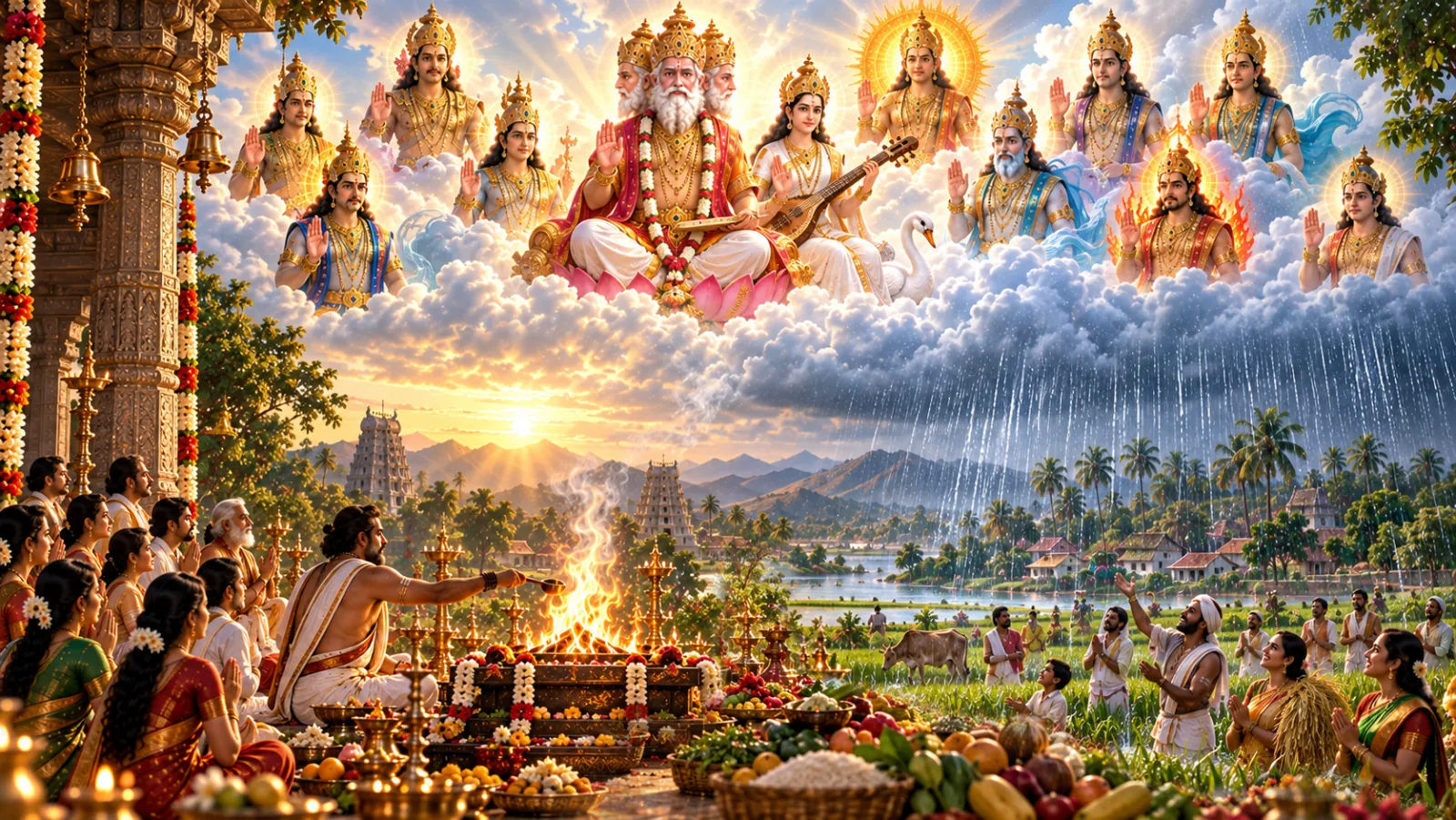
“Living beings are sustained by food; food arises from rain; rain arises from yajña; and yajña arises from right action.”
What sustains one life
is meant to sustain all of it.
The Vedic tradition speaks of five great yajñas — five sacred obligations through which a human being acknowledges the forces, the beings and the wisdom that sustain life. “There are five great yajñas,” says the Śatapatha Brāhmaṇa, naming them plainly.
पञ्चैव महायज्ञाः । तान्येव महासत्राणि ।
भूतयज्ञो मनुष्ययज्ञः पितृयज्ञो देवयज्ञो ब्रह्मयज्ञ इति ॥
To the Devas
Homa — honouring the divine forces that sustain the cosmic order.
 To the ancestors
Tarpaṇa — honouring our ancestors, through whom life, lineage and tradition have come to us.
 To the Ṛṣis
Honouring the Ṛṣis through learning, preserving and transmitting sacred knowledge.
 To all beings
Bali — our responsibility toward living beings and the natural world.
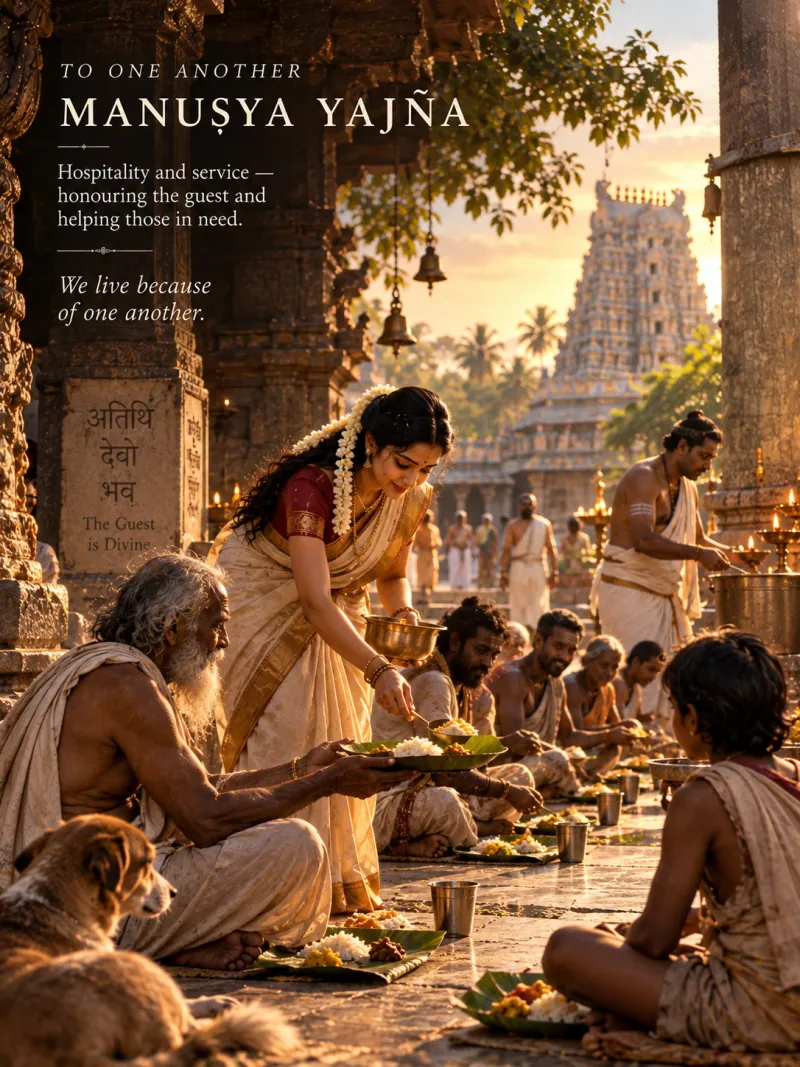 To one another
Our duty toward fellow human beings, guests and society.
अध्यापनं ब्रह्मयज्ञः पितृयज्ञस्तु तर्पणम् ।
होमो दैवो बलिर्भौतो नृयज्ञोऽतिथिपूजनम् ॥
adhyāpanaṁ brahma-yajñaḥ pitṛ-yajñas tu tarpaṇam
homo daivo balir bhauto nṛ-yajño ’tithi-pūjanam
“Teaching is Brahma Yajña; tarpaṇa is Pitṛ Yajña; homa is Deva Yajña; bali is Bhūta Yajña; honouring the guest is Nṛ Yajña.”
Yajña is the Vedic
act of offering.
A yajña is not a single moment. It is a sequence, and each step carries the devotee’s intention further — from a thought held privately, to an offering received by the Devatā.
The Gītā is careful on this point. One who enjoys what has been given, while offering nothing, is described as living wrongly (3.12); those who share what has first been offered are freed from impurity (3.13). The offering itself is the act — not the outcome sought from it.
Your conscious intention, declared with your name, gothram and nakshatra.
The sacred invocation, by which the Devatā is called into the fire.
The offering — ghee, grains and the prescribed substances — placed into Agni.
The sacred fire, the medium that carries what is offered onward.
The divine presence invoked, who receives the offering.
The complete offering that seals the yajña, carrying every sankalpa with it.
Not for what may be obtained, but for what the act itself asks of us.
Remembering and revering the divine forces that sustain existence.
Cultivating gratitude for what is continually received.
Bringing one’s intention consciously into sacred action.
Developing the understanding that life itself is an offering.
Swamiji names the blessings through which a human life is sustained — six at the foundation, and sixteen in full. The yajña is performed as an act of devotion and sankalpa; its fruits are understood as the grace of the Devatā, never as a mechanical transaction.
Long life · Health · Wealth · Good fortune · Peace · Bliss
Good health and vitality
Longevity
Wealth and material security
Abundance of food and nourishment
Knowledge and wisdom
Good name and honour
Courage and strength
Lineage and children
Good fortune and auspiciousness
Inner peace and harmony
Joy and contentment
Harmony in the home
Success in endeavours
Righteousness and integrity
Radiance and vitality of spirit
Liberation, the final aim
The sixteen anugrahas are divine blessings — not to be confused with the sixteen saṁskāras, the sacred rites of passage.
The Purāṇas do not present yajña as a transaction. They tell of kings whose yajñas were joined to dharma and to generosity — and of what followed.
A righteous ruler who performed great yajñas for the welfare of his people and the world. The Bhāgavatam describes the abundance that followed: the earth yielding food, trees giving fruit and honey, and cows giving milk in plenty. His prosperity is never shown as his alone — it is the flourishing of the land and everyone upon it.
The Bhāgavatam records that Bharata regularly worshipped through yajña, including the Agnihotra and the Darśa and Pūrṇamāsa — the Vedic rites of the new moon and the full moon. A reminder of how long these two days have been honoured through the sacred fire. The Amavasya and Pournami yagams →
Ambarīṣa performed great yajñas with generous gifts to the learned. Yet the Bhāgavatam never presents his wealth as the goal. His prosperity is joined to devotion, to dharma and to giving — and it is that union the text honours.
Vena forbade the performance of yajña and set aside the counsel of the sages, who warned him that right worship is bound up with the welfare of a kingdom. The Bhāgavatam describes the disorder that followed — the other side of Pṛthu’s story.
True prosperity, in this tradition, is not one person’s wealth.
It is the flourishing of people, food, nature and society together.
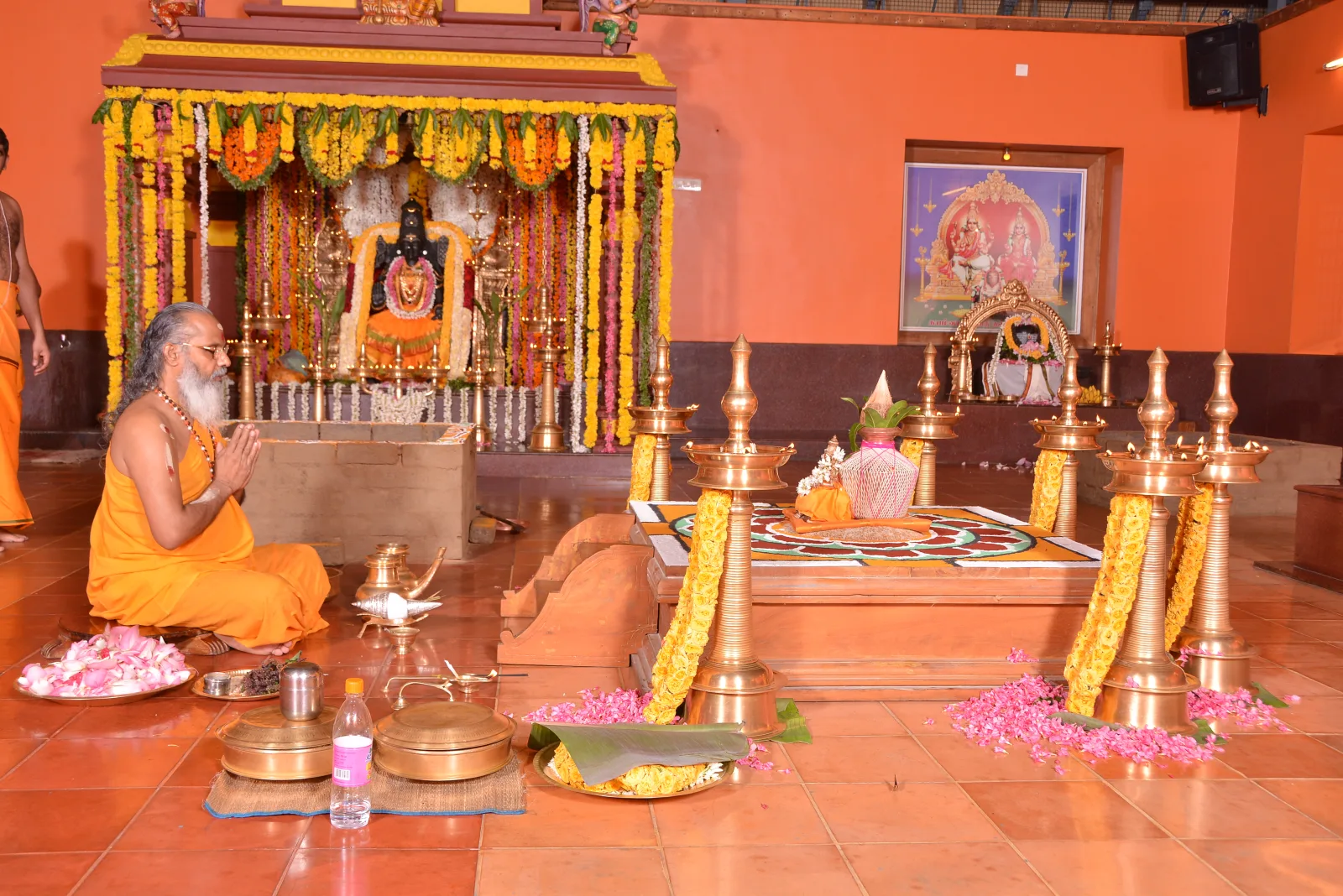
At the Sree Suryamangalam Bagalamukhi Devi Temple, Deva Yagna is offered as the Deva Agni Hotra Yagam — an Agni yajña performed according to the temple’s own Atharvana Veda procedure, invoking the Divine through the sacred fire at sunrise and at sunset.
It is not kindled from a new flame. The Yaagaagni — the sacred fire drawn from arani — has been kept alive and unbroken at the Peetam for more than twenty-five years, and every yagam here is performed from that same lineage of fire. Each mantra is chanted a full ten thousand times.
Your sankalpa is what makes the yajña yours. Your name, gothram and nakshatra are recited aloud by the acharyas, so that the offering is bound to you and your family rather than made generically — and devotees who have booked a sankalp are given the opportunity to dedicate their prayer directly into the Yaagaagni, a practice unique to this temple. You are not merely purchasing a ritual; you are placing your intention into a living tradition.
Devotees offer a sankalp for good health, prosperity, happiness, protection and the well-being of the family. It is conducted by the acharyas of the Sree Suryamangalam Advaitha Veda Vidhya Peetam, under the guidance of Rajaguru Brahmasri Guruvayur Vishvamithra Gothra Suryan Namboothiry Acharyar (Peetathipathi). A sankalp may be offered in person at Tirunelveli, or from anywhere in the world.
Where a teaching is Swamiji’s own exposition rather than a quoted text, it is marked as such on this page.